


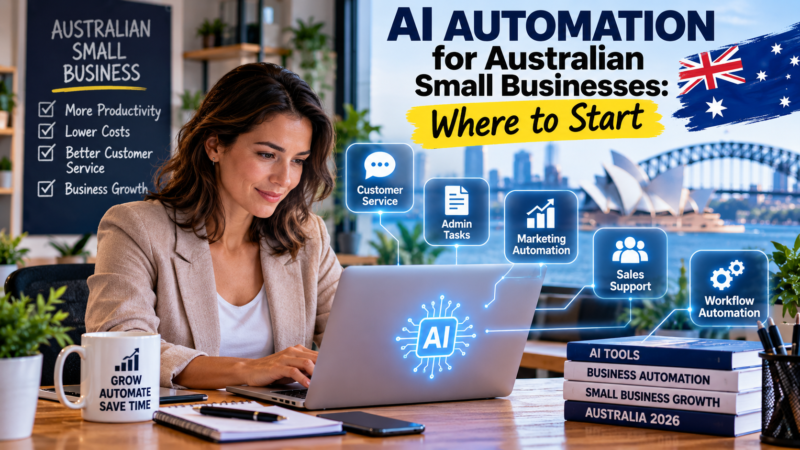
Kayonews-Artificial intelligence is becoming increasingly practical for Australian small businesses. Owners can now automate repetitive tasks without building expensive AI systems from scratch.
The biggest opportunity is not replacing employees. Instead, businesses can use AI to reduce repetitive work and give staff more time for customers, sales and important decisions.
Australia’s business.gov.au recommends starting small. Businesses can trial AI in one or two areas, compare tools and assess accuracy before expanding their use.
1. Start With Repetitive Tasks
The easiest place to begin is with work that happens repeatedly.
Examples include answering common customer questions, writing routine emails, summarising documents, preparing meeting notes, creating social media drafts and organising information.
If an employee performs the same task several times every week, it may be a potential automation opportunity.
Start by listing the tasks that consume the most time. Then identify which tasks require human judgment and which can follow a predictable process.
2. Automate Customer Enquiries
Customer service is one of the most practical applications for AI automation.
An AI chatbot can help answer frequently asked questions about opening hours, products, services, delivery information and basic policies.
However, businesses should provide a clear path to a human employee when a question is complex or sensitive.
Australian businesses should also consider privacy obligations when deploying customer-facing AI systems. The Office of the Australian Information Commissioner says organisations should conduct appropriate due diligence and consider privacy, security, accuracy and human oversight.
3. Use AI for Email and Administration
Small businesses often lose hours every week managing emails and administrative tasks.
AI can assist with drafting replies, summarising long email threads, extracting information from documents and preparing routine communications.
For example, a business could create a workflow where incoming enquiries are classified automatically before being assigned to the appropriate employee.
This can reduce manual sorting while keeping employees responsible for important decisions.
4. Automate Marketing Workflows
AI can also support marketing teams and business owners.
Possible applications include generating content ideas, preparing social media drafts, creating email campaign concepts and summarising campaign performance.
Businesses can combine AI with marketing automation software to create repeatable workflows.
For example, a new customer could trigger an automated welcome email, followed by a reminder several days later.
Human review remains important, especially when AI-generated content contains claims about products, prices or customers.
5. Connect AI With Existing Software
Australian small businesses do not necessarily need a completely new technology system.
Many automation platforms can connect existing applications, including email, accounting, customer relationship management, calendars and project-management tools.
A simple workflow might look like this:
Customer enquiry → AI classification → CRM update → Staff notification → Follow-up email
This approach can create significant efficiency without requiring a custom AI application.
Business.gov.au notes that off-the-shelf AI products are generally quicker and easier to implement, while custom solutions can provide greater flexibility but typically require more investment and ongoing maintenance.
6. Protect Customer Data
Data protection should be considered before connecting AI to business systems.
Australian businesses need to understand what information an AI provider receives, where information is processed and who may have access to it.
The OAIC recommends caution when entering personal information into publicly available generative AI tools. It also recommends considering data flows, security controls, accuracy and whether providers can access information submitted to their systems.
Businesses should therefore avoid putting sensitive customer information into an AI tool without first understanding the applicable privacy requirements and the provider’s data practices.
7. Create an AI Policy
An internal AI policy can help employees understand what they can and cannot do with AI tools.
The policy could cover approved applications, prohibited information, human review requirements, customer disclosure and security procedures.
Australia’s National AI Centre has also published Guidance for AI Adoption, including practical resources such as an AI policy template and AI register template.
A simple policy can be enough for a small business starting its AI journey.
8. Measure the Business Result
AI automation should produce a measurable business benefit.
Before launching an automation, record how much time employees currently spend on the task.
Then compare the result after implementation.
Useful measurements include:
- Hours saved per week
- Customer response time
- Number of automated tasks
- Employee productivity
- Lead response time
- Customer satisfaction
- Administrative costs
- Sales conversion rates
This makes it easier to determine whether an AI subscription is actually delivering value.
9. Don’t Automate Everything
More automation does not automatically mean a better business.
Some tasks require empathy, professional judgment, creativity or detailed knowledge of the customer.
For these tasks, AI may work better as an assistant rather than a fully automated replacement.
Business.gov.au recommends bringing staff into the process, providing training and starting with limited AI trials before expanding across the organisation.
A Simple AI Automation Roadmap
For a small Australian business starting from zero, the process can be straightforward.
Step 1: List repetitive tasks.
Step 2: Select one low-risk workflow.
Step 3: Choose an appropriate AI or automation tool.
Step 4: Test the workflow with limited data.
Step 5: Add human review.
Step 6: Measure time and cost savings.
Step 7: Improve the workflow.
Step 8: Expand automation to another business process.
This approach reduces the risk of spending money on complicated technology before proving its value.
FAQ: AI Automation for Australian Small Businesses
What is AI automation for small businesses?
AI automation uses artificial intelligence and software workflows to perform or assist with repetitive business tasks, such as customer enquiries, document processing, marketing and administration.
What should a small business automate first?
Start with repetitive, low-risk tasks that consume significant employee time. Email sorting, document summaries, appointment management and frequently asked customer questions can be suitable starting points.
Is AI automation expensive in Australia?
Costs vary significantly. Off-the-shelf tools can provide a relatively inexpensive way to experiment, while custom AI systems generally require greater development, integration and maintenance costs.
Can AI automate customer service?
Yes. AI can handle common questions and assist with customer-service workflows. Businesses should provide human escalation for complex or sensitive matters.
Can Australian businesses put customer data into AI tools?
Businesses should first assess their privacy obligations, the AI provider’s data practices and the security risks. OAIC guidance recommends particular caution when entering personal information into publicly available generative AI tools.
Should small businesses replace employees with AI?
AI automation can instead be used to support employees by reducing repetitive work. Business.gov.au recommends involving staff, providing training and introducing AI gradually.
What is the best way to start AI automation?
Start with one measurable, low-risk workflow. Prove that it saves time or improves a business outcome before expanding to additional processes.
AI automation does not have to begin with a major technology investment. For many Australian small businesses, the practical starting point is identifying one repetitive task and testing whether AI can make that process faster, more consistent and easier to manage.(*)