

Kayonews-US mortgage rates remain elevated on September 15, 2026, with borrowing costs hovering around the highest levels seen in more than a year. Homebuyers are watching rates closely as the Federal Reserve begins its September 15-16 policy meeting.
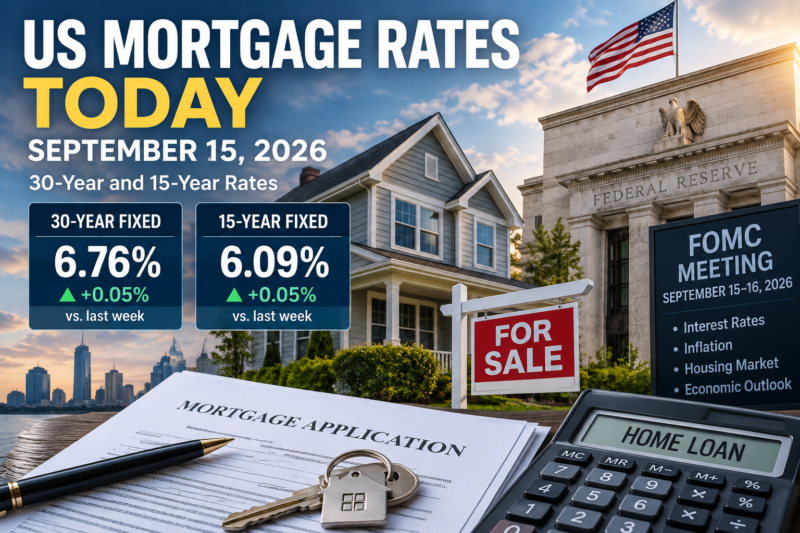
The latest official weekly data from Freddie Mac show that the average 30-year fixed mortgage rate is 6.76%, while the average 15-year fixed mortgage rate is 6.09% as of September 10. The 30-year rate increased from 6.71% the previous week, while the 15-year rate rose from 6.04%.
Meanwhile, daily lender-rate surveys show rates moving around the high-6% range. Bankrate data cited by the Wall Street Journal put the average 30-year fixed purchase mortgage at about 6.90% on September 14, with the 15-year fixed rate at approximately 6.24%.
Mortgage Rates Today: 30-Year vs. 15-Year
| Mortgage type | Latest average rate |
|---|---|
| 30-year fixed | 6.76% Freddie Mac weekly average |
| 15-year fixed | 6.09% Freddie Mac weekly average |
| 30-year fixed purchase | ~6.90% Bankrate daily survey |
| 15-year fixed purchase | ~6.24% Bankrate daily survey |
Rates can vary significantly by lender, borrower credit score, down payment, loan size, property type and discount points.
Why Are Mortgage Rates Rising?
One of the biggest factors is the bond market.
The 10-year U.S. Treasury yield recently approached 5%, increasing pressure on mortgage rates. Rising oil prices and persistent inflation concerns have also contributed to higher Treasury yields and borrowing costs.
The housing market is already feeling the impact. U.S. existing-home sales fell 2% in August to a seasonally adjusted annual rate of 3.98 million units, the lowest level in 14 months, while the median existing-home price reached $429,100.
What Is the Federal Reserve Doing?
The Federal Reserve’s September 15-16 meeting is particularly important for mortgage borrowers.
Recent economic developments have changed expectations about monetary policy. A Reuters poll published September 14 found that 85% of economists expected the Fed to raise its benchmark rate by 25 basis points to a 3.75%-4.00% range at the September meeting.
However, mortgage rates do not move one-for-one with the federal funds rate. Fixed mortgage rates are influenced heavily by longer-term Treasury yields, inflation expectations and investor demand for mortgage-backed securities.
That means a Fed rate hike does not automatically mean mortgage rates will rise by the same amount.
How Much Would a Mortgage Cost at Today’s Rates?
Consider a $400,000 30-year fixed mortgage at a 6.76% interest rate.
The estimated principal-and-interest payment would be roughly $2,600 per month, before property taxes, homeowners insurance, mortgage insurance and other costs.
For a $400,000 15-year mortgage at 6.09%, the estimated principal-and-interest payment would be around $3,400 per month.
The 15-year loan comes with a substantially higher monthly payment, but the borrower pays off the mortgage much faster and can save a significant amount of interest over the life of the loan.
Actual payments depend on the loan amount, rate, fees, down payment and borrower qualifications.
Should You Buy a Home at 6%+ Mortgage Rates?
There is no universal answer.
A buyer who can comfortably afford the monthly payment and plans to stay in the property for many years may decide that waiting for lower rates is not worth the risk of higher home prices or reduced inventory.
On the other hand, buyers who would struggle with today’s payment may benefit from waiting, increasing their down payment or improving their credit profile.
The key is to compare the total cost of the mortgage, not just the advertised interest rate.
Should You Lock Your Mortgage Rate Now?
A rate lock can protect a borrower from market increases between the mortgage application and closing.
But borrowers should compare offers from several lenders before locking. Even a relatively small difference in mortgage rates can translate into thousands of dollars over the life of a loan.
Ask lenders about:
- Interest rate
- APR
- Origination fees
- Discount points
- Closing costs
- Rate-lock period
- Prepayment penalties
- Estimated monthly payment
Mortgage Rate Outlook for the Rest of 2026
The outlook remains uncertain.
Mortgage rates are being pulled in different directions by inflation, Treasury yields, Federal Reserve policy, oil prices and economic growth.
The latest Freddie Mac data already show the 30-year mortgage rate at 6.76%, up from 6.35% a year earlier. The 15-year rate has also risen to 6.09% from 5.50% a year ago.
For prospective homebuyers, the most important number may not be the national average but the actual rate and APR offered by individual lenders.
Bottom Line
US mortgage rates remain above 6% on September 15, 2026. Freddie Mac’s latest weekly survey puts the average 30-year fixed rate at 6.76% and the 15-year fixed rate at 6.09%. Daily lender surveys are somewhat higher, illustrating how quickly mortgage pricing can change.
With the Federal Reserve meeting underway and Treasury yields near multiyear highs, borrowers should expect continued volatility.
If you’re shopping for a mortgage, compare multiple lenders, look at the APR and closing costs, and calculate the payment based on your own budget rather than relying solely on the national average. (*)
Editor : Fanda Yosephta