


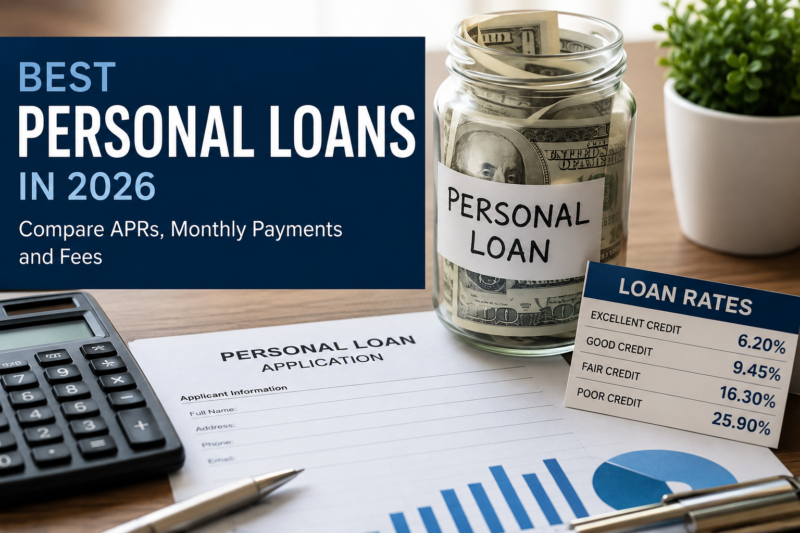
Jakarta-Finding the best personal loan in August 2026 means looking beyond the advertised interest rate. Borrowers should compare the annual percentage rate (APR), monthly payment, loan term, origination fees, funding speed and eligibility requirements before choosing a lender.
Current personal loan rates vary significantly by borrower. Bankrate reports that the best personal loan rates currently start around 6.20%, while typical APRs range from about 8% to 36%. Its latest data puts the average personal loan rate at 12.43%.
For borrowers with excellent credit, the lowest advertised rates can be considerably below what borrowers with fair or poor credit receive. NerdWallet’s latest August data shows average rates of 14.85% for borrowers with credit scores of 720 or higher, 19.54% for scores of 690-719, 23.78% for scores of 630-689 and 27.30% for scores below 630.
Best Personal Loans in August 2026
There is no single personal loan that is best for every borrower. The right choice depends on your credit profile, loan amount, repayment period and purpose.
Current lender comparisons show several competitive options.
SoFi is among the leading online personal-loan options, with an advertised APR range of 6.99% to 35.49% and loan amounts of up to $100,000, according to Bankrate’s latest comparison.
LightStream offers APRs from 7.24% to 24.89% in Bankrate’s current comparison and can be particularly attractive for borrowers seeking larger loans or home-improvement financing.
Upgrade lists APRs from 7.74% to 35.99% and is positioned as an option for debt consolidation.
Discover lists APRs from 7.99% to 24.99% and is highlighted by Bankrate for loans without fees.
Upstart lists APRs from 6.20% to 35.99% and may be worth considering for borrowers with limited credit histories, although approval and the actual rate depend on individual underwriting.
Other lenders appearing in current August comparisons include Best Egg, Achieve, LendingClub, Prosper, Avant, OneMain Financial and Rocket Loans. Their available APRs vary widely, making it important to compare personalized offers rather than relying only on the advertised minimum rate.
Personal Loan Rates by Credit Score
Your credit score can have a major effect on the cost of borrowing.
NerdWallet’s August 2026 data shows the following average rates from users who pre-qualified for personal loans:
| Credit Score | Average APR |
|---|---|
| 720-850 | 14.85% |
| 690-719 | 19.54% |
| 630-689 | 23.78% |
| Below 630 | 27.30% |
These are aggregate rates from pre-qualified borrowers, not guaranteed offers. Your actual APR can differ based on income, debt-to-income ratio, payment history, loan amount, term and lender requirements.
How Much Does a Personal Loan Cost?
Consider a hypothetical $20,000 personal loan with a five-year repayment term.
At a 10% APR, the monthly payment would be approximately $425, before considering any applicable fees.
At a 15% APR, the monthly payment would be approximately $475.
At a 25% APR, the monthly payment would be approximately $587.
The difference in monthly payments can become substantial over the full repayment period. A longer loan term may reduce the monthly payment but can increase the total interest paid.
Always calculate both the monthly payment and the total repayment amount before accepting an offer.
APR vs. Interest Rate: What’s the Difference?
The interest rate tells you the cost of borrowing expressed as a percentage.
APR is more useful when comparing personal loans because it can incorporate the interest rate and certain loan fees, such as an origination fee.
For example, a loan with a slightly lower interest rate could still have a higher overall borrowing cost if it carries significant fees.
The Truth in Lending Act requires lenders to disclose the APR before a borrower signs a loan agreement.
Watch Out for Origination Fees
Some personal lenders charge an origination fee when the loan is issued. The fee may be deducted from the loan proceeds or added to the cost of borrowing.
For example, if you are approved for a $20,000 loan but the lender charges a 5% origination fee, you could receive only $19,000 in proceeds while still owing according to the loan’s repayment terms.
This is why comparing APR rather than simply comparing the advertised interest rate is important.
Some lenders advertise no-fee loans, while others may charge origination fees depending on the borrower and loan product.
How to Get the Lowest Personal Loan Rate
The best way to find a competitive rate is to compare multiple offers.
First, check your credit reports and credit score. A higher credit score can improve your chances of receiving a lower APR.
Next, compare lenders that allow prequalification with a soft credit inquiry. Prequalification can allow you to see potential rates without necessarily triggering a hard credit inquiry.
You should also compare:
- APR
- Loan amount
- Repayment term
- Monthly payment
- Origination fees
- Late fees
- Prepayment penalties
- Funding speed
- Credit requirements
Don’t automatically choose the lender advertising the lowest starting APR. The advertised minimum may only be available to borrowers with excellent credit and strong financial profiles.
Personal Loans for Debt Consolidation
Debt consolidation is one of the most common uses for personal loans.
A borrower may use a personal loan to consolidate multiple high-interest debts into one fixed monthly payment. This can simplify repayment and potentially reduce interest costs if the new loan has a lower APR.
However, consolidation is not automatically cheaper.
Borrowers should compare the new loan’s APR, fees and total interest against the existing debt. A longer repayment period could reduce the monthly payment while increasing the total amount of interest paid.
Credit card rates remain substantially higher than many personal loan rates. Recent U.S. data shows credit card APRs remain above 20%, making debt-consolidation comparisons particularly relevant for consumers carrying balances.
Personal Loan Alternatives
A personal loan isn’t always the cheapest financing option.
Depending on your situation, alternatives may include a 0% introductory APR credit card, home equity loan, HELOC, personal line of credit or another financing option. Each has different risks and costs.
Homeowners should be particularly careful when comparing unsecured personal loans with home-equity products. A personal loan generally does not require your home as collateral, while a home-equity loan or HELOC is secured by your property.
What to Expect From Personal Loan Rates
Personal loan rates remain highly dependent on the borrower’s credit profile and the lender’s underwriting criteria.
Bankrate’s current August comparison shows advertised rates ranging from roughly 6.20% at the low end to as high as 35.99% for some lenders.
NerdWallet’s data similarly shows a wide gap between excellent-credit and bad-credit borrowers. That means the most important question is not simply “What is the average personal loan rate?” but rather “What rate can I qualify for?”
Bottom Line
The best personal loan in August 2026 is the one that offers you the lowest overall borrowing cost while meeting your needs for loan amount, repayment term and funding speed.
Current market comparisons show competitive starting APRs around 6% to 7%, but many borrowers will receive substantially higher offers depending on credit and financial circumstances.
Before applying, compare at least several lenders, use prequalification when available, examine the APR and fees, and calculate the total cost of the loan.
For borrowers carrying expensive credit-card debt, a personal loan may be worth considering for consolidation—but only if the new loan genuinely reduces borrowing costs and the borrower avoids accumulating new high-interest debt. (*)