


Kayonews-Your credit score can change even when you don’t realize you’ve done anything wrong.
A late payment is an obvious example, but your score can also be affected by changes in credit utilization, new applications, account closures, reporting errors, and other factors.
Because your credit profile can influence your ability to qualify for loans and credit cards—and potentially the rates you’re offered—understanding what can hurt your score is important.
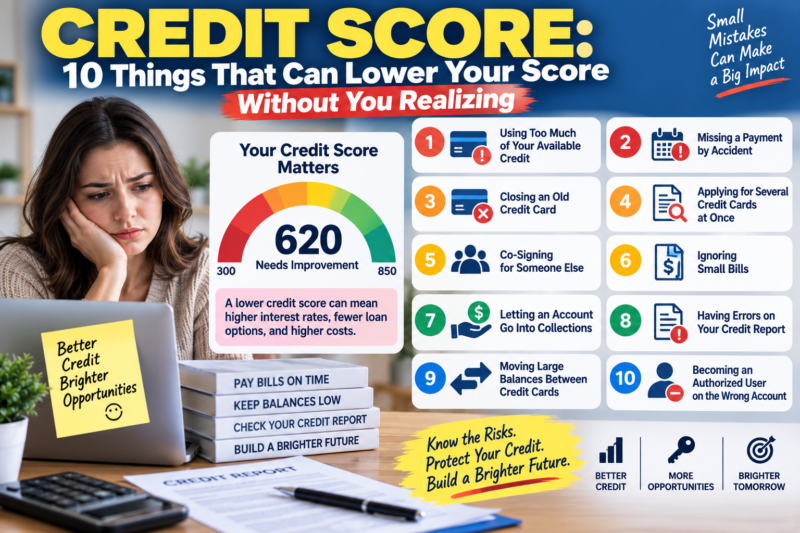
Here are 10 things that can lower your credit score without you realizing it.
1. Using Too Much of Your Available Credit
One of the most important factors in many credit-scoring models is credit utilization—how much of your available revolving credit you’re using.
For example, if your credit cards have a combined limit of $10,000 and your reported balances total $7,000, your utilization is 70%.
A high utilization ratio can negatively affect your score.
You don’t necessarily need to carry a balance to build credit. Paying balances on time and keeping reported utilization under control can be important.
2. Missing a Payment by Accident
A missed payment can become a serious problem, particularly when it is reported to the credit bureaus.
Common reasons include:
- Forgetting a due date
- Changing bank accounts
- A payment failing automatically
- Insufficient funds
- Confusing statement dates with payment dates
Setting up automatic payments for at least the minimum amount due can help prevent accidental missed payments.
3. Closing an Old Credit Card
Closing an old credit card may seem harmless, but it can affect your credit profile.
Closing an account can reduce your available revolving credit, potentially increasing your overall utilization ratio.
The effect depends on your individual credit history and the scoring model being used.
Before closing an older account, consider how it could affect your overall credit profile.
4. Applying for Several Credit Cards at Once
Every application isn’t necessarily treated the same way, but applying for multiple credit accounts in a short period can create several hard inquiries and signal increased demand for credit.
Instead of applying for every card that offers a promotion, research eligibility requirements first.
Only apply when the account fits your financial needs.
5. Co-Signing for Someone Else
Co-signing a loan or credit account means you may become responsible for the debt if the primary borrower doesn’t pay.
The account can also become part of your credit profile.
If the borrower misses payments or the account becomes seriously delinquent, your credit can potentially be affected.
Never co-sign simply because someone asks you to. Understand the financial and credit consequences first.
6. Ignoring Small Bills
A small bill can still become a big credit problem if it becomes seriously delinquent or is sent to collections.
Don’t assume a small balance doesn’t matter.
If you receive a bill you believe is incorrect, contact the company and dispute the charge promptly.
Keep records of your communications and payments.
7. Letting an Account Go Into Collections
Unpaid accounts can eventually be sent to collection agencies.
Depending on the circumstances and how the information is reported, collection accounts can affect your credit history.
If you’re struggling to pay a bill, contact the creditor before the account becomes seriously delinquent.
Early communication may provide options such as payment arrangements or hardship programs.
8. Having Errors on Your Credit Report
Sometimes the problem isn’t something you did.
Your credit report may contain inaccurate information, such as:
- An account you don’t recognize
- Incorrect payment history
- Wrong account balances
- Duplicate accounts
- Incorrect personal information
- Accounts that should no longer be reported
Checking your credit reports regularly can help you identify potential errors.
If you find inaccurate information, you can dispute it with the appropriate credit reporting company and the company that supplied the information.
9. Moving Large Balances Between Credit Cards
A balance transfer can sometimes reduce interest costs, but opening a new account or transferring balances can change your utilization and credit profile.
For example, transferring a large balance to a new card with a relatively low credit limit could result in high utilization on that account.
Always consider the overall effect before moving debt.
10. Becoming an Authorized User on the Wrong Account
Being added as an authorized user can sometimes help a person’s credit profile, but it isn’t automatically beneficial.
If the account has high balances, missed payments, or other negative information, it could potentially have the opposite effect depending on how the account is reported and the scoring model.
Before becoming an authorized user, understand the account’s payment history and credit utilization.
What Is a Good Credit Score?
Credit-scoring ranges vary depending on the scoring model.
For the widely used FICO Score system, scores generally range from 300 to 850.
FICO describes scores from 670 to 739 as “Good,” 740 to 799 as “Very Good,” and 800 or above as “Exceptional.”
However, lenders can use different scoring models and additional information when evaluating applications.
Therefore, there isn’t one universal score that guarantees approval.
How Can You Improve Your Credit Score?
If your score has fallen, focus on the fundamentals.
Pay Bills on Time
Payment history is a major component of many credit-scoring models.
Set reminders or automatic payments to reduce the chance of missing due dates.
Reduce Credit Card Balances
Lowering revolving balances can reduce your credit utilization and may help your score.
Avoid Unnecessary Credit Applications
Apply for new credit only when you actually need it.
Check Your Credit Reports
Review your reports for inaccurate or suspicious information.
Keep Older Accounts Open When Appropriate
Older accounts can contribute to the length and depth of your credit history, although whether to keep an account open depends on your individual circumstances.
How Often Should You Check Your Credit Report?
Regularly checking your credit report can help you spot errors and potential fraud.
Consumers can obtain free credit reports through the official federally authorized service.
If you find an account or transaction you don’t recognize, investigate it promptly.
Does Checking Your Own Credit Hurt Your Score?
Generally, checking your own credit report is considered a soft inquiry and does not hurt your FICO Score.
This is different from a hard inquiry that can occur when you apply for certain types of new credit.
Can Paying Off a Credit Card Lower Your Score?
Paying off credit card debt is generally a positive financial step.
However, your score can sometimes change after an account balance is updated because credit-scoring models consider the information reported at a particular point in time.
A temporary score fluctuation does not necessarily mean you’ve done something wrong.
FAQ: Credit Score 2026
What lowers your credit score the most?
Late payments, high credit utilization, collections, and other negative information can have significant effects. The impact depends on the scoring model and your overall credit history.
How fast can I improve my credit score?
There is no guaranteed timeline. Paying bills on time, reducing revolving balances, and correcting inaccurate information can help improve your credit profile over time.
Does closing a credit card hurt your credit?
It can, depending on the account and your overall credit profile. Closing a card can reduce available revolving credit and potentially increase utilization.
Does checking my credit score lower it?
Checking your own credit generally does not lower your FICO Score because it is treated as a soft inquiry.
How much credit card utilization is too high?
There is no universal cutoff that guarantees a particular score. However, lower revolving utilization is generally better than carrying high balances relative to your available limits.
Can credit repair companies remove accurate negative information?
Legitimate negative information generally cannot simply be removed because it is unfavorable. Be cautious of companies promising to erase accurate negative information or guarantee a specific credit score.
Bottom Line
Your credit score can fall for reasons that aren’t immediately obvious.
High credit utilization, missed payments, new applications, closed accounts, collections, co-signing, and inaccurate credit-report information can all affect your credit profile.
The best approach is to monitor your credit report, pay bills on time, keep revolving balances under control, and only apply for credit when necessary.
A strong credit profile doesn’t happen overnight—but consistent financial habits can make a meaningful difference over time.(*)