


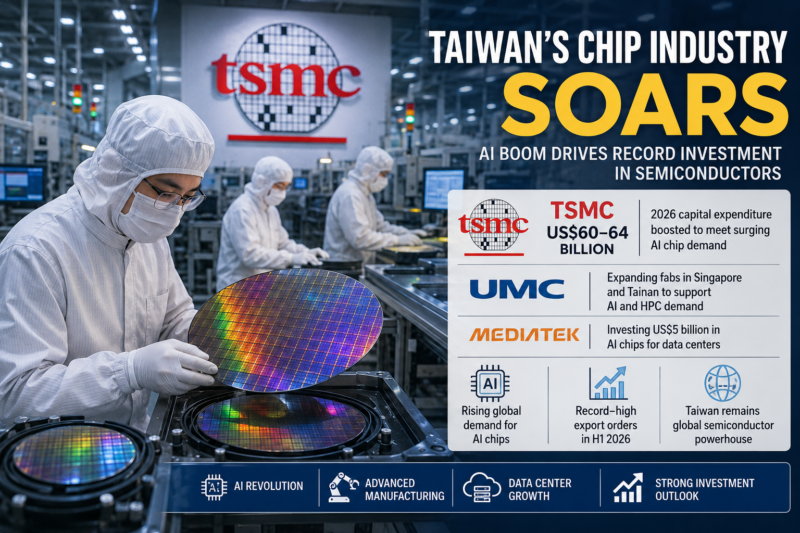
Kayonews-The global artificial intelligence (AI) race is creating a new wave of investment across Taiwan’s semiconductor industry. As demand for AI chips, high-performance computing (HPC), and data center processors continues to surge, Taiwanese chipmakers are expanding production capacity at an unprecedented pace. The trend is reinforcing Taiwan’s position as the world’s most important semiconductor manufacturing hub while attracting the attention of investors, technology companies, and financial markets.
Taiwan Semiconductor Manufacturing Company (TSMC), the world’s largest contract chipmaker, recently raised its 2026 capital expenditure guidance to between US$60 billion and US$64 billion. The company said the additional investment will support long-term demand for AI processors, advanced manufacturing technologies, and next-generation chip packaging. TSMC also continues expanding production facilities in Arizona as global customers seek greater supply-chain resilience.
The AI investment boom is not limited to TSMC. United Microelectronics Corp. (UMC) has approved higher capital spending for 2026 by expanding cleanroom capacity in Singapore and building a new fabrication plant in Tainan, Taiwan. The expansion is designed to meet rising customer demand driven by AI applications, industrial automation, and cloud computing infrastructure.
Meanwhile, MediaTek is aggressively diversifying beyond smartphone chips by investing US$5 billion to develop custom AI processors for hyperscale data centers. The company expects AI-related products to become one of its fastest-growing businesses and forecasts billions of dollars in annual AI-chip revenue over the next few years as cloud providers continue increasing AI infrastructure spending.
Analysts believe the AI revolution is creating a multi-year growth cycle for Taiwan’s semiconductor industry. Demand for AI accelerators, advanced GPUs, custom ASICs, memory chips, and CoWoS advanced packaging continues to outpace supply. Major technology companies including Nvidia, Apple, Microsoft, Amazon, Google, and Meta rely heavily on Taiwan’s semiconductor ecosystem to power next-generation AI services and cloud platforms.
The investment surge is also strengthening Taiwan’s broader economy. Higher semiconductor exports, rising manufacturing output, and increasing foreign investment are expected to support economic growth while creating thousands of high-skilled jobs. Financial analysts note that semiconductor stocks remain among the strongest-performing technology investments as AI adoption accelerates across industries.
Despite geopolitical uncertainties and global competition, industry experts expect Taiwan to maintain its leadership in advanced semiconductor manufacturing for years to come. Continued investment in 2-nanometer technology, advanced packaging, AI servers, and high-performance computing is expected to keep the island at the center of the global digital economy.
For investors, businesses, and technology enthusiasts, Taiwan’s semiconductor expansion represents more than a manufacturing story. It signals the next phase of the AI revolution, where demand for powerful chips will shape everything from cloud computing and autonomous vehicles to robotics, healthcare, and generative AI applications worldwide.
FAQ
1. Why is Taiwan’s semiconductor industry growing so rapidly?
The rapid expansion is driven by soaring global demand for AI chips, cloud computing infrastructure, and advanced semiconductor technologies.
2. Which Taiwanese company leads the AI chip supply chain?
TSMC remains the world’s leading semiconductor foundry and manufactures advanced chips for many global technology companies.
3. Why are investors paying attention to Taiwan’s chip sector?
Strong AI demand is boosting revenue, capital investment, and long-term growth prospects for semiconductor companies.
4. Which companies besides TSMC are benefiting?
UMC, MediaTek, packaging companies, equipment suppliers, and memory manufacturers are all expanding their AI-related businesses.
5. What industries will benefit from Taiwan’s chip expansion?
Artificial intelligence, cloud computing, autonomous vehicles, consumer electronics, healthcare technology, robotics, and enterprise data centers are expected to benefit significantly. (Tim)
Editor : Fanda Yosephta