


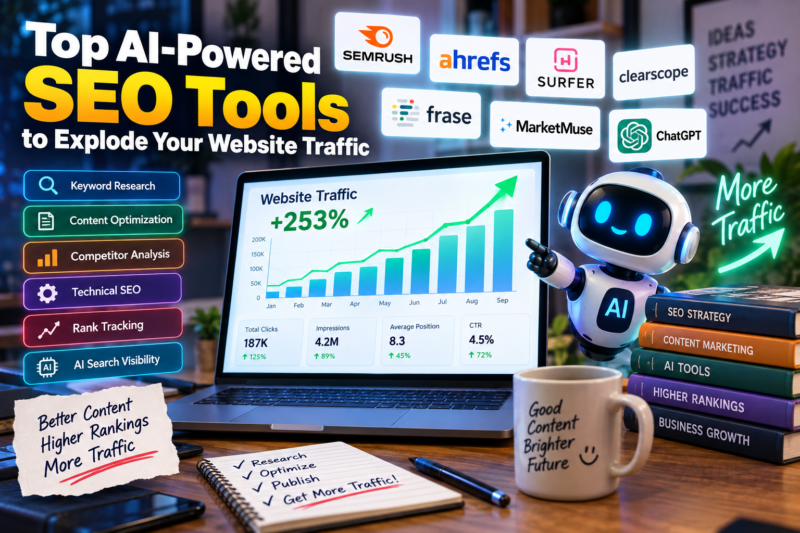
Kayonews-SEO is no longer just about stuffing keywords into articles. In 2026, AI-powered SEO tools can help publishers discover valuable search queries, analyze competitors, optimize content, identify technical problems, track rankings, and even monitor how a brand appears in AI-generated answers.
Industry comparisons this year consistently put platforms such as Semrush, Ahrefs, Surfer SEO, Clearscope, Frase, and MarketMuse among the leading AI-assisted SEO solutions.
The key is not simply choosing the tool with the most AI features. The biggest traffic gains usually come from combining good search data + strong content optimization + technical SEO + continuous measurement.
1. Semrush — Best All-in-One AI SEO Platform
Best for: publishers, agencies, businesses and large content websites.
Semrush remains one of the strongest choices for an all-in-one SEO workflow. Its ecosystem covers keyword research, competitor analysis, site auditing, content optimization and visibility in AI-generated search results. Recent 2026 comparisons rank it among the leading overall AI SEO platforms.
Why it stands out
- Keyword research
- Competitor analysis
- Backlink research
- Technical SEO audits
- Content optimization
- Rank tracking
- AI-search visibility
- Content ideation
Traffic strategy: Find keywords where competitors already receive traffic but your site has little or no visibility, then build better pages targeting those opportunities.
Verdict: ⭐⭐⭐⭐⭐
Best overall choice for serious SEO operations.
2. Ahrefs — Best for Competitor & Backlink Intelligence
Best for: competitor research, backlinks and discovering content opportunities.
Ahrefs combines Site Explorer, Keywords Explorer, Site Audit, Rank Tracker and Content Explorer with newer AI capabilities such as AI Content Helper and Brand Radar. Its tools can analyze competitor traffic, backlinks, keyword opportunities and technical SEO issues.
A powerful workflow
- Enter a competitor’s domain.
- Find pages generating organic traffic.
- Identify their keywords.
- Look for keywords where your site isn’t ranking.
- Create a more useful article.
- Build relevant internal and external links.
- Track the results.
Verdict: ⭐⭐⭐⭐⭐
Best choice when competitor intelligence and backlinks are priorities.
3. Surfer SEO — Best for Content Optimization
Best for: bloggers and publishers producing large amounts of SEO content.
Surfer focuses heavily on analyzing search results and helping writers optimize pages for the topics and concepts associated with ranking content. Current 2026 comparisons continue to highlight it as a leading content-optimization platform.
It can help with:
- Content briefs
- Topic coverage
- Semantic terms
- On-page optimization
- Content scoring
- SERP analysis
- AI-assisted content workflows
Traffic strategy: Don’t use the AI simply to make an article longer. Use SERP analysis to determine what information users actually expect and make the article substantially more useful.
Verdict: ⭐⭐⭐⭐⭐
Excellent for websites publishing dozens of articles every month.
4. Clearscope — Best for High-Quality Content Teams
Best for: professional editorial teams and businesses where content quality is critical.
Clearscope is designed around content optimization and increasingly focuses on visibility across traditional search and AI platforms. Its current platform includes tracking for mentions across AI services such as ChatGPT, Gemini and Claude.
Particularly useful for
- Content briefs
- Existing-page optimization
- Topic coverage
- Content quality control
- AI visibility monitoring
Verdict: ⭐⭐⭐⭐½
A strong option for professional content operations.
5. Frase — Best for SEO Content Research
Best for: solo bloggers, affiliate publishers and smaller content teams.
Frase focuses on simplifying the research-to-content workflow. It can help analyze search results, create content briefs and organize topics before writing.
That makes it useful when you want to move from:
Keyword → SERP research → outline → article → optimization
without having to manually perform every step.
Verdict: ⭐⭐⭐⭐½
Good value for content-focused publishers.
6. MarketMuse — Best for Content Strategy
Best for: websites with large content libraries.
MarketMuse is particularly useful when the problem isn’t simply “what article should I write?” but rather:
Which topics should my entire website cover?
AI-assisted topic modeling and content inventories can help identify gaps and opportunities across a website. It is frequently included among the leading AI SEO platforms for content planning.
Verdict: ⭐⭐⭐⭐
Better suited to strategic content planning than quick keyword research.
7. ChatGPT — Best Flexible AI SEO Assistant
ChatGPT can be extremely useful as an SEO workflow assistant, but it shouldn’t replace actual SEO datasets.
Use it to:
- Generate article outlines
- Analyze search intent
- Create FAQ ideas
- Develop content angles
- Rewrite titles
- Build internal-link suggestions
- Cluster keywords
- Create schema drafts
- Analyze competitors’ content that you provide
- Brainstorm Discover-friendly headlines
- Turn keyword research into editorial plans
However, keyword volume, ranking positions, backlinks and traffic estimates should be validated with dedicated SEO platforms and first-party analytics. Current SEO guidance similarly emphasizes using AI to accelerate analysis rather than inventing search data.
Verdict: ⭐⭐⭐⭐⭐ as an assistant, but not a replacement for SEO data tools.
The New SEO Battlefield: AI Search Visibility
One of the biggest changes in 2026 is that SEO increasingly extends beyond traditional Google rankings.
Your website may need visibility in:
- Google’s AI-generated results
- ChatGPT
- Gemini
- Perplexity
- Claude
- Microsoft Copilot
Ahrefs, for example, now provides Brand Radar for monitoring visibility across several AI platforms, while Clearscope also provides AI-platform visibility tracking.
That means a modern SEO strategy should ask two questions:
1. Does my page rank in search results?
2. Does AI recommend or cite my website when users ask relevant questions?
The Best AI SEO Stack for Maximum Traffic
You don’t necessarily need 10 subscriptions.
A practical setup could look like this:
| SEO Job | Recommended Tool |
|---|---|
| Keyword research | Semrush / Ahrefs |
| Competitor research | Ahrefs / Semrush |
| Technical SEO | Semrush / Ahrefs |
| Content optimization | Surfer / Clearscope |
| Content research | Frase |
| Content strategy | MarketMuse |
| AI-assisted writing | ChatGPT |
| AI visibility | Ahrefs / Clearscope |
| Performance measurement | Google Search Console + Analytics |
The strongest platforms increasingly combine traditional SEO with AI-search visibility rather than treating them as completely separate disciplines.
How to Actually Increase Website Traffic With AI
Buying an AI SEO subscription won’t automatically explode traffic.
The workflow matters more.
Step 1: Find realistic keywords
Don’t target only huge keywords.
Look for low-to-medium competition keywords with clear search intent.
For example:
“best credit card”
may be extremely competitive.
A more specific query such as:
“best credit card for travel rewards in Indonesia”
may provide a more realistic opportunity.
Step 2: Analyze the SERP
Before writing, study the pages already ranking.
Determine:
- What questions do they answer?
- What information are they missing?
- How comprehensive are they?
- What formats appear?
- Are there FAQs?
- Are there statistics?
- Are there comparison tables?
Step 3: Build a better article
AI can help structure the article, but the finished page should contain original information, useful analysis and trustworthy sources.
Step 4: Optimize existing content
Don’t only publish new articles.
Find pages that rank around positions 5–20 and improve them.
These can sometimes produce faster traffic gains than starting from zero.
Step 5: Strengthen internal links
Connect related articles into topic clusters.
For example:
Main topic: Personal Finance
→ KPR
→ Refinancing
→ SLIK OJK
→ Credit cards
→ PayLater
→ Investment
→ Gold
This helps users navigate your site and makes your topical coverage clearer.
Step 6: Measure everything
Track:
- Impressions
- CTR
- Average position
- Organic clicks
- Indexed pages
- Conversions
- Revenue per visitor
- Returning visitors
Then repeat what works.
The Most Important AI SEO Mistake to Avoid
Don’t publish hundreds of generic AI-generated articles simply because AI makes production cheap.
Search engines and users have little reason to prefer another generic article that repeats information already available elsewhere.
Instead, use AI to increase the speed of research and optimization while improving the usefulness of the final content.
A good formula is:
AI efficiency + reliable data + original expertise + strong search intent = sustainable organic traffic
Final Ranking
| Rank | Tool | Best For |
|---|---|---|
| 🥇 1 | Semrush | All-in-one SEO |
| 🥈 2 | Ahrefs | Competitors & backlinks |
| 🥉 3 | Surfer SEO | Content optimization |
| 4 | Clearscope | Premium content optimization |
| 5 | Frase | Content research |
| 6 | MarketMuse | Content strategy |
| 7 | ChatGPT | Flexible AI SEO workflows |
For most serious websites, Semrush or Ahrefs + a content optimizer such as Surfer/Clearscope + Google Search Console + an AI assistant is a much more powerful combination than relying on one AI writing tool alone. Current 2026 comparisons likewise place the major all-in-one suites and specialized content tools at the center of the AI SEO ecosystem. (*)
Editor : Fanda Yosephta